
Why Smart Digital Assistants Still Struggle with Mass Adoption, and How to Fix It
Smart digital assistants including Amazon's Alexa, Google's Gemini for Home, and Apple's Siri continue advancing with enhanced dialogue capabilities and broader device integration. By 2025, billions of devices globally will feature voice assistant technology.
Despite these improvements, wide-scale adoption beyond early adopters and tech enthusiasts remains uneven. Four core challenges keep voice-first experiences from reaching the everyday mainstream, and each one is solvable with the right testing discipline.
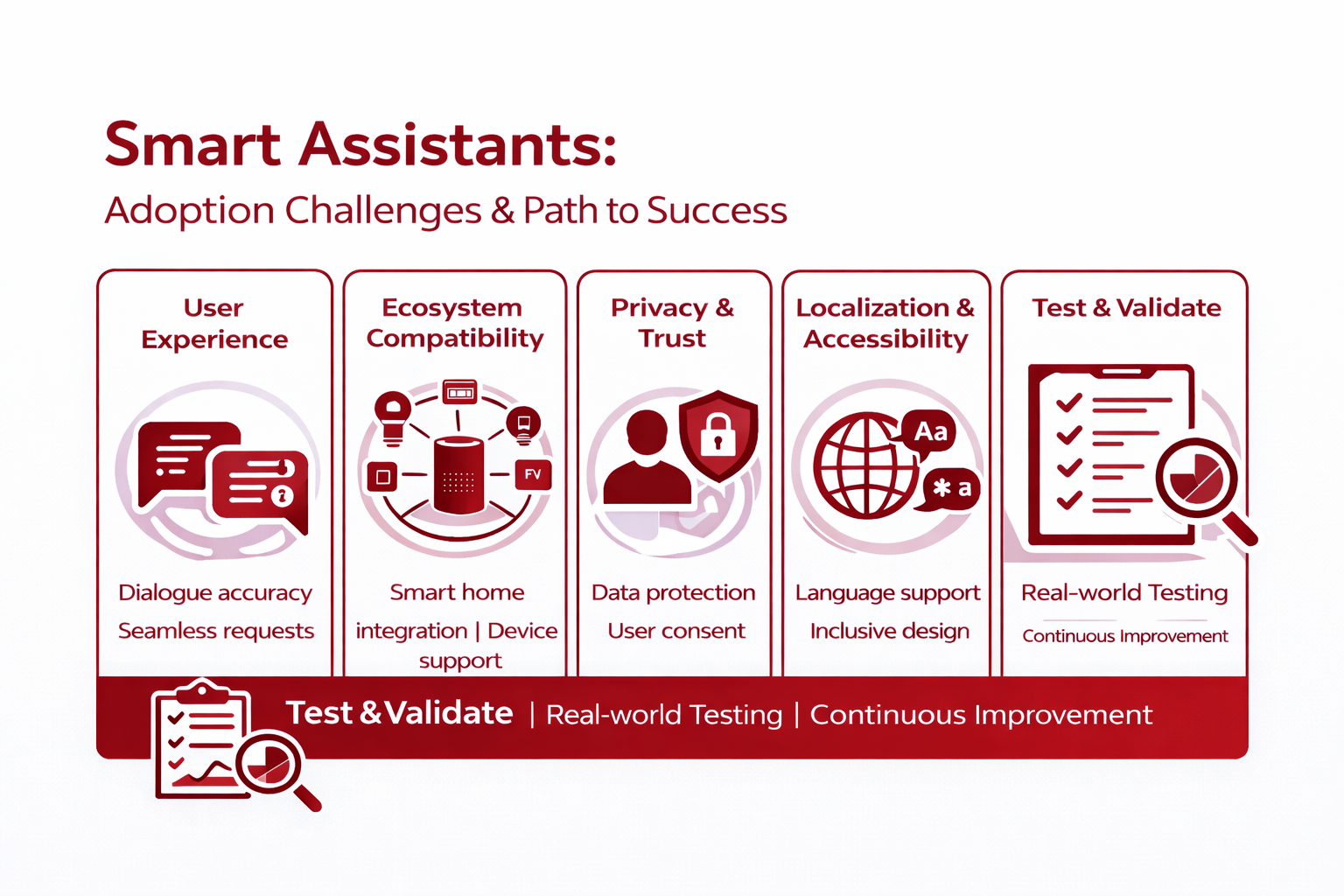
1. User Experience: Expectations vs. Reality
Consumers anticipate conversational AI that proves dependable and user-friendly. Current-generation assistants show problems with reliability, memory retention, and processing intricate sequential commands.
Solution: Conduct authentic testing across varied demographics and real-world conditions, not just controlled demos, to enhance accuracy and natural conversation flow.
2. Interoperability & Ecosystem Fragmentation
Voice platforms must integrate with countless smart home devices seamlessly. Though Alexa shows extensive device support, compatibility challenges persist whenever new AI capabilities launch.
Solution: Execute comprehensive integration assessments with manufacturing partners and align on universal technical frameworks before features ship to customers.
3. Privacy, Trust & Transparency
Voice platforms inevitably gather personal information. Studies indicate that privacy safeguards and ease-of-use frequently conflict, particularly among younger demographics.
Solution: Implement privacy-first design, transparent setup instructions, and intuitive permission management, so users understand the trade-offs and trust the defaults.
4. Localized Intelligence & Accessibility
Language comprehension must function across diverse linguistic backgrounds, speech patterns, and regional variations. Engagement drops without location-specific training data.
Solution: Continuous algorithmic refinement supported by inclusive evaluation practices that represent the people who will actually use the product.
The Critical Success Requirement: Rigorous Testing
Market leaders achieve widespread consumer trust through dependable real-world performance. That means:
- Gradual public testing phases that capture genuine usage behavior
- Performance tracking that emphasizes task-completion rates and satisfaction, not just uptime
- Collaborative review involving design, engineering, security, and customer service teams
Widespread adoption correlates with experiences users perceive as effortless, trustworthy, and genuinely useful in their daily lives. Technology that disappears into the background, not the one that demands attention, is what wins the mainstream.
How Novus Labs Can Help
Our engineers have tested voice-enabled products in controlled lab environments and real-world residential test homes, across the full spectrum of interoperability scenarios you'll encounter in the wild.
If you're building a smart assistant experience, connect with us today to start tackling your interoperability challenges.